
On September 27, 2025 PSG goals analysi , Paris Saint‑Germain welcomed Auxerre to the Parc des Princes for a Ligue 1 clash that looked, on paper, like one favoring the capital side. But this match carried extra weight: PSG had just suffered their first defeat of the season and needed to reset ahead of a key Champions League fixture. Luis Enrique made bold selection choices, resting several of his marquee names and unveiling a rotated side. What might have looked like a risk on paper instead became an exercise in discipline, structure, and—most importantly—set‑piece precision.
PSG claimed a 2–0 victory, and, as many observers noted, both goals stemmed from short-corner routines rather than traditional open play attacks. That strategic approach underscores how seriously PSG now treat set pieces—not as an afterthought, but as a weapon.
In this long-form blog, we’ll walk you through:
- The pre-match context and selection decisions
- How the first goal unfolded: movement, execution, and delivery
- The second goal: repetition, variation, advantage
- Defensive structure, limiting Auxerre’s threat
- The role of rotation: risks and rewards
- What this result means for PSG’s momentum
- Potential weaknesses, what to watch next
- Broader reflections on modern set-piece strategy

-
Pre-match context & selection decisions
1.1 A slip in momentum
Just days earlier, PSG had suffered their first league defeat of the 2025–26 campaign, succumbing to Marseille. That result reverberated through the fanbase and media alike: PSG were expected to dominate domestically, and a loss—even to a rival—raises questions about consistency, depth, and psychological resolve.
Thus, the Auxerre match was more than a routine fixture. It was a litmus test: could Luis Enrique’s side bounce back with composure? Could they manage fatigue ahead of European duty?
1.2 Rotated squad, but still shrewd
Knowing they would face Barcelona midweek, Enrique opted to rest a few key players—those whose minutes he had to manage. Some names, like Ousmane Dembélé, were absent (for injury reasons), but beyond that, Enrique deliberately reshuffled
Rotation always carries risk: cohesion might suffer, mistakes can creep in, and match rhythm for bench players can be patchy. But it also offers benefits: fresh legs, surprise factor, and momentum for peripheral players to prove their worth.
In this match, Enrique needed his starters to perform when called upon—even if they lacked recent minutes. The message was clear: no complacency, no excuses.
1.3 Auxerre’s approach and threat
While Auxerre arrived without the same firepower as PSG, they are never to be underestimated. In recent seasons, they’ve threatened with quick switches, counterattacks, and opportunistic crossings. In fact, in previous matches, Enrique had remarked that Auxerre “know how to switch the play well” and can exploit the flanks
Hence, PSG’s plan could not solely depend on dominant possession or flashy dribbles; they needed set-piece stability, compact structure, and a degree of control.
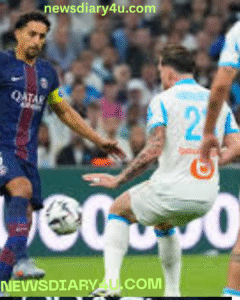
-
The first goal: anatomy of a set-piece breakthrough
2.1 Game flowr up to the opene
For much of the first half, PSG probed Auxerre’s defenses with occasional flurries, especially down the flanks. Khvicha Kvaratskhelia threatened, as did Lee Kang-in. But the breakthrough didn’t come from open play. Instead, it arrived from a corner routine—one PSG had clearly rehearsed.
2.2 The corner setup
The corner was not taken in the conventional way. PSG deployed an identical short-corner routine twice, designed to shift Auxerre’s defensive shape and open gaps around the 6-yard box.
Here’s how it worked, in simplified steps:
- The taker (Vitinha) receives the corner from wide, not in one lofted delivery but in a short-pass format.
- The ball is recycled, quickly moved, with overlapping runs or decoys drawing markers out of position.
- Meanwhile, at the far post, a movement is pre-planned (Zabarnyi, a center back, backs off to that zone).
- The final cross is delivered into the vacated zone where the marker is stretched thin.
- Zabarnyi meets it on the volley and finishes with a left-footed strike.
That sequence capitalized on two things:
- Positional confusion: defenders focusing on blockers or decoys
- Man-marking stretch: in short-corner schemes, you pull defenders laterally or out of their vertical chord
The technique paid off. The ball sailed to the back post, and Illia Zabarnyi volleyed it home.
This was Zabarnyi’s first goal for PSG, a memorable one under pressure in a tight match.
2.3 Why this goal mattered beyond the scoreline
- Psychological boost: Opening the scoring generates confidence, especially when the side is rotated.
- Proof of planning: It’s one thing to train routines; it’s another to score from them in a competitive match.
- Opponent scrambling: Auxerre suddenly had to reorganize under the burden of conceding from something premeditated.
-
The second goal: variant but consistent
3.1 Return from halftime, same artifice
After the break, PSG did not abandon their approach. They continued focusing on structure, tempo, and set-piece chances. Early in the second half, Bradley Barcola missed a promising opportunity. But PSG kept probing
Minutes later, they returned to a short-corner variation. The pattern mirrored the first goal, but with slight tweaks.
3.2 The setup and finish
This time:
- Senny Mayulu played the key cross, from the corner zone, following a short-pass build-up.
- Lucas Beraldo, another central defender, made the finishing run—this time into the space vacated by defenders.
- He met Mayulu’s cross with a header and scored
One could argue the second goal was more orthodox (header), but it still emerged from the same philosophy: stretching the defense via short-corner mechanics. The fact that PSG could replicate the tactic immediately speaks to the training and confidence in execution.
3.3 The importance of variation
While the second set-piece echoed the first, PSG did not copy it exactly. Slight adjustments in run timing, delivery, and decoy positioning ensured Auxerre could not simply park blockers in the same way they defended the first time. That fluidity is essential—if you become predictable, the opponent adapts.
-
Controlling the game: defense, midfield, and shape
A victory built on set pieces still requires solidity everywhere else. PSG’s success rested on more than two goals.
4.1 Defensive discipline
Though rotated, PSG’s backline held firm. Auxerre never truly looked like breaching deep. When they attempted to switch play or send in crosses, PSG’s defenders stayed organized, maintained line discipline, and closed down spaces.
4.2 Midfield balance and transitions
Luis Enrique’s rotation didn’t lead to disjointed midfield play. He struck a balance between containment and forward edge. When PSG lost possession, they counter-pressed coherently enough to discourage Auxerre’s fluid attacks.
4.3 Minimizing risk from open play
By focusing their attacking threat through set pieces, PSG removed some burden from open play. They didn’t force risky overcommitments. That helped in transitions: Auxerre’s counters had fewer opportunities to exploit disjointed structure.
4.4 Psychological control
Holding the lead, particularly through set pieces, puts psychological pressure on the opponent. PSG managed time, possession, and tempo in ways that prevented Auxerre from regaining composure.

-
Rotation: balancing fresh legs and cohesion
Running a heavily rotated side can backfire—individuals might misread cues, alignment might suffer, and errors creep in. Yet PSG avoided major mishaps.
5.1 Risks inherent in rotation
- Lack of match sharpness: Players who rarely feature risk being off in timing or decision-making.
- Chemistry breaks: Partnerships—especially backline or midfield—rely on understanding.
- Reduced margin for error: In tight games, small mistakes often cost more.
But in this case, PSG managed rotation well. The defensive pairing, the midfield transitions, and the attacking runs behind were synchronized enough to avoid critical mistakes. That speaks to the quality of depth and coaching.
5.2 Who stepped up
Zabarnyi and Beraldo—both defenders—scored crucial goals. Midfield support from the likes of Vitinha in delivery and Mayulu in connecting passes were also on point. Bench or fringe players had moments to shine and contributed to the collective mission.
Rotation also allows the manager to keep his main squad fresh for congested fixtures. In this case, PSG had Champions League business looming. Thus, using peripheral players in a high-stakes match—and extracting performance—reflects positively.
-
Momentum, morale, and table implications
6.1 Regaining confidence
After a defeat, recovering immediately is vital. PSG did just that. A clean, composed 2–0 scoreline rebuilds belief. It tells the dressing room: “We still have control, even if we rotate.”
6.2 Position in Ligue 1
With this win, PSG moved to 15 points at the top of the league, three points clear of multiple chasers In a tightly contested domestic campaign, every match carries weight—this one added more value by reinforcing PSG’s claim to leadership.
6.3 European preparation
With Barcelona awaiting in midweek, PSG could approach the tie with some calm. The confidence from this performance, especially the capacity to rotate and still win, gives Enrique tactical flexibility for handling minutes and fatigue.
-
Caveats & what to watch next
7.1 Overreliance on set pieces?
While the match highlighted PSG’s capacity in dead-ball situations, one wonders: what happens when set-piece chances dry up? A team can’t rely solely on corners or short-corner routines every match. PSG must continue refining their open-play threat.
7.2 Defensive vulnerabilities remain
Even on a clean sheet, rotated lineups can show cracks under consistent pressure. Auxerre weren’t able to expose them this time, but stronger teams will test them. PSG must remain vigilant, especially when rotation is extended.
7.3 Predictability trap
If PSG overuse similar set-piece routines, opponents may adapt. Variation, secrecy, shifting runs, decoy patterns—all become critical to keep rivals guessing.
7.4 Fitness and fatigue across competitions
Rotation helps, but for players getting fewer minutes, sustaining peak fitness is a challenge. Judicious minute management will remain vital throughout the season.
-
Broader reflections: The evolution of set-piece strategy in modern football
PSG’s approach in this match exemplifies how teams no longer treat set pieces as “bonus opportunities” but as integral components of attack. Across elite leagues, coaches invest heavily in set-piece coaches, video analysis, biomechanics, delivery precision, and randomized routines.
Here are some thoughts:
- Short-corner dominance: The shift from traditional lofted balls to short, controlled trickery is clear. It stresses marking structure more than aerial duels.
- Movement synergy: The decoys, overlaps, and delayed runs force defenders to choose who to track—often incorrectly.
- Training investment pays: When a team can replicate a routine in match pressure, it tells you those movements aren’t ad hoc—they’re practiced until muscle memory.
- Psychological leverage: Conceding a goal from a planned routine sends mental signals: you’re being out-thought, not out-played.
- Set‑piece as equalizer: Even rotated squads or underdogs can score from routines—if they train them well. In modern football, match edge often lies in margins.
PSG’s 2–0 victory over Auxerre didn’t just reward them with three points. It demonstrated depth, structure, and coaching clarity. If they continue blending set-piece mastery with open-play fluidity, they may present a full challenge—both domestically and in Europe.
Conclusion
The match between PSG and Auxerre was never destined to hinge on flashes of genius from star forwards. Instead, it hinged on discipline, planning, and execution—especially from set pieces. Luis Enrique’s rotated side walked onto the pitch with a blueprint: trust routines, manage structure, and make smart use of depth. The result: a composed 2–0 win that quieted doubts and reasserted PSG’s credentials.
Zabarnyi and Beraldo, both defenders, delivered the goals—not from frenetic attacking flair but from rehearsed routines. The rest of the side maintained shape, composure, and balance. Auxerre, to their credit, tried to battle back, but they never truly dominated.
As the season unfolds, PSG must avoid complacency. They must continue evolving open-play attack, preserve defensive resilience under rotation, and keep their set-piece arsen