
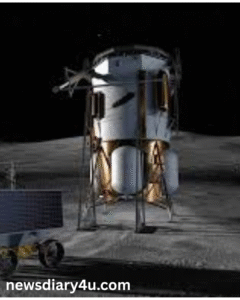
Blue Origin , founded by Jeff Bezos, has been positioning itself as a major partner in lunar commerce and NASA’s Artemis efforts. They created the Blue Moon lander series to deliver payloads, VIPER Rover Moon missionequipment, and eventually crewed–related infrastructure to the Moon. The Mark 1 variant is an uncrewed cargo/Science/Instrument delivery lander under CLPS.
Blue Origin’s first MK1 mission is due around 2025, carrying smaller payloads (cameras, retroreflectors, etc.). The VIPER mission would use a second MK1 lander. That means that Blue Origin will have to demonstrate reliable lander performance by that time
Blue Moon MK1: Capabilities and Unknowns
- Capabilities: Designed to carry moderate-sized payloads to the lunar surface; one of those payloads will be VIPER in this mission’s case. It requires precise landing capabilities, thermal control, and the ability to offload the rover reliably. Integration of VIPER’s systems, deployment mechanism, and interfaces are all part of what Blue Origin must prove. Unknowns / Development Needs: Although Blue Origin has made announcements and has plans, full flight performance for MK1 is yet unproven as of the time of the contract. There is also risk in delivering in very challenging terrain, especially near permanently shadowed areas. The manner in which the rover deploys in low-light, possibly steep terrain, and the rover’s own ability to operate in cold and flashlight‑like or limited light conditions must be validated.
- Demonstration of mission architecture and flight readiness before full execution is part of NASA’s conditions.
Why 2027 Matters: Timing & Strategic Impacts
Fulfilling Artemis Objectives
NASA’s Artemis program aims at returning humans to the Moon, building sustainable presence, and possibly using the Moon as a stepping stone for Mars. To do that efficiently, knowing where resources like water ice are, how to access them, and what environmental challenges exist is vital. If VIPER delivers on time, data will inform Artemis’s human landing site selection, habitat designs, life support, and in‑situ resource utilization (ISRU) planning
Cost, Risk & Reinvestment
By resurrecting VIPER through a cost‑controlled partnership, NASA demonstrates it is willing to adapt and reuse existing assets rather than starting from scratch. Since VIPER was essentially built already, using it (instead of scrapping or cannibalizing its instruments) saves both money and scientific opportunity. The $190 million CLPS contract with Blue Origin spreads risk and leverages private development.
Maintaining International Leadership & Scientific Momeothers in Europe, India, Japan, etc. By moving ahead with VIPER, NASA retains momentum in lunar science and exploration. Delays or cancellations reduce credibility, slow down associated science fields, and allow others to claim “firsts.” Securing a 2027 delivery keeps the U.S. in the lead in polar lunar resource exploration.
Implications for Future Missions & ISRU (In‑Situ Resource Utilization)
Data collected by VIPER can directly feed into:
- Mapping resource locations: Where is ice thick, deep, accessible, or shielded from radiation?
- Assessing accessibility: Is ice mixed with soil? Is it at shallow depths? How easy (or difficult) would extraction be?
- Thermal, power, and light environment mapping: For habitat design, earthlighting, circuits, thermal insulation, battery/fuel cell or radioisotope usage, etc.
- Technology demonstrations: Drills, sensors, robotics and mobility in low‑light and cold. That helps for Mars missions or for permanently shadowed lunar bases.
- Policy, law, and sustainability aspects: Resource utilization in space comes with regulatory, environmental, ethical questions. Data from VIPER may inform international agreements, policies, and how nations view resource rights and sharing in space.
Risks & Concerns
Even with careful planning, this mission has risks and potential drawbacks.
- Missing deadlines: If Blue Origin fails to deliver MK1’s first flight, or if integration/delivery milestones slip, 2027 may be optimistic.
- Budget overruns: As with many space programs, costs could rise especially when dealing with unknowns in corrosion, vacuum, extreme cold, communication, etc.
- Technical failures on the rover: Instruments, drill, sensors, mobility could degrade or fail, especially in extremes of cold or repeated thermal cycling.
- Landing site hazards: The terrain near the Moon’s south pole is rugged; craters are deep, slopes steep, dust and debris dangerous. Safe landing and subsequent mobility are non‑trivial.
- Power and communication challenges: Less solar illumination means reliance on batteries or alternate power sources; communications may require relays or may suffer if terrain blocks line of sight.
- Environmental issues: Dust, extreme cold, micrometeorite impacts, radiation—all of these degrade performance over time.
What to Watch Moving Forward
Here are some key milestones and indicators to track, if you’re following VIPER:
- Blue Origin’s first Blue Moon MK1 flight success
Demonstrating the lander’s capacity, control, navigation, ascent, descent, and safe landing, with lighter payloads first. - Technical readiness / reviews
Integration tests of rover + lander, thermal/vacuum/environmental qualification, especially in cold shadowed region analogs.
Mission design and landing site selection
NASA and Blue Origin will need to pick a landing site that balances scientific payoff (rich in volatiles) with safety (terrain, communications, thermal profile - Blue Origin’s first Blue Moon MK1 flight success
Broader Context: Artemis, Lunar Policy, Competition
To understand VIPER’s importance, it helps to situate it in the broader space landscape.
The Artemis program aims not just to land astronauts, but to build a reusable, sustainable Moon presence: habitats, infrastructure, science, and ultimately leveraging lunar resources. VIPER is part of enabling that. Globally, multiple nations are looking at lunar polar regions, especially for ice resources: China, ESA, India, etc. Whoever maps first and well could influence future collaboration, commercial mining, and scientific priority
Broader Context: Artemis, Lunar Policy, Competition
To understand VIPER’s importance, it helps to situate it in the broader space landscape.
The Artemis program aims not just to land astronauts, but to build a reusable, sustainable Moon presence: habitats, infrastructure, science, and ultimately leveraging lunar resources. VIPER is part of enabling that. Globally, multiple nations are looking at lunar polar regions, especially for ice resources: China, ESA, India, etc. Whoever maps first and well could influence future collaboration, commercial mining, and scientific priority
Conclusion
NASA’s decision to revive VIPER and assign Blue Origin to deliver it to the Moon by late 2027 marks a turning point. It shows that despite setbacks, the agency values the science, the resource prospecting, and the strategic importance of the lunar south pole. By leveraging private industry, existing hardware, and a flexible contract structure, NASA hopes to achieve